

True Certified — Bellevue, West View & the North Hills
True Repair Near Me in Bellevue, West View & the North Hills, Allegheny County, PA
Local True appliance repair near you in Bellevue, West View & the North Hills — certified neighborhood technicians, genuine OEM parts, same-day availability across Allegheny County.
Mon–Sat 7am–8pm · Sun 9am–5pm
Schedule Your Repair
Service Type
What type of service do you need?
Or call us directly:
(412) 912-1088True Appliances We Repair in Bellevue, West View & the North Hills
How True builds appliances, and why it matters
The True line dates to 1945 and grew out of United States, which still shapes how the equipment is put together; commercially it occupies the commercial tier. What actually matters to a repair is the engineering commitment to commercial refrigeration, forced-air and reach-in units for foodservice. That single decision sets the load path through the machine, and the load path sets the failure list — which is why a True fault list is not interchangeable with any other brand's. For owners in Allegheny County it also sets the economics, since owners here keep appliances a long time — a fifteen-year-old machine in daily service is unremarkable, and the repair-versus-replace calculation tilts toward repair more often than in newer markets.
Servicing True well comes down to one piece of brand knowledge — True units are built for continuous duty and repay preventive coil and gasket maintenance more than most equipment. Without it a technician will condemn the wrong component often enough that the customer ends up funding the learning curve. That is a worse trade in Pittsburgh than in most markets, because parts run through Pittsburgh-area distributors with next-day access to Cleveland and Philadelphia stock.
In practice that means we approach True equipment with a specific order of checks rather than a generic one. Building around commercial refrigeration changes what a noise, a temperature drift or an intermittent electrical fault most likely indicates, and starting from the brand's actual architecture is faster and cheaper than starting from the symptom alone. In Pittsburgh we add one more input before touching anything: 60-amp and early 100-amp panels are still in service in pre-war housing, and a dedicated 20-amp appliance circuit is the exception rather than the rule.
True and the Pittsburgh operating environment
No two markets treat a True the same way, and Pittsburgh has its own signature. What dominates here is winter cold and repeated freeze–thaw cycling, with basements and garages routinely dropping below the roughly 40°F ambient that household refrigeration is rated for. Service intervals published for True assume an average environment that Pittsburgh simply is not, with the result that continuous-duty commercial equipment reaches those intervals well ahead of schedule.
For True the housing matters as much as the climate. Allegheny County is one of the oldest housing stocks in the country, much of it predating 1940, with narrow rowhouse kitchens, steep basement stairs and hillside access — which is the environment every True appliance here operates in. For True specifically, that intersects with door gaskets, condenser fans and defrost controls under continuous duty — the physical installation determines both how quickly that failure develops and whether it can be repaired in place when it does.
The third variable is the water supply. Pittsburgh runs moderately hard water at roughly 7–9 grains per gallon, and it arrives at True inlet valves, spray arms and every other wetted component exactly as supplied — the appliance does nothing to condition it. Our refrigeration peak is winter rather than summer, which inverts the pattern most manufacturers design their service guidance around. True equipment tracks that calendar closely.
The True faults that bring us out
Across True equipment in Pittsburgh, the recurring failures concentrate around door gaskets, condenser fans and defrost controls under continuous duty. That is a True pattern rather than a general appliance pattern, and recognising it before opening the machine is most of the diagnostic work.
True refrigerator, freezer, wine-cooler are all within scope, along with the rest of the line. The diagnostic routes barely overlap between categories even inside a single brand, which is why we do not run one generic checklist across them. In Allegheny County the balance of what comes in tracks the housing stock closely, because owners here keep appliances a long time — a fifteen-year-old machine in daily service is unremarkable, and the repair-versus-replace calculation tilts toward repair more often than in newer markets.
Where True equipment faults intermittently, the installation is the first thing we rule out and the control board is close to the last. On commercial machines that sequencing is worth real money to the customer, because the two ends of that list differ in cost by an order of magnitude — and in Allegheny County the expensive end also carries a wait, since parts run through Pittsburgh-area distributors with next-day access to Cleveland and Philadelphia stock.
On top of the brand pattern sits the local one. With winter cold and repeated freeze–thaw cycling as the dominant stressor, exposed True components run ahead of their design ageing curve — the failure that shows up at year eight in a gentler market can arrive at year five in Pittsburgh.
Continuous duty and why domestic assumptions do not transfer
Commercial equipment is engineered for a completely different duty cycle: hundreds of cycles a day, continuous refrigeration, and operation in hot, humid, high-traffic environments. Applying domestic diagnostic assumptions to it produces wrong answers, and applying domestic service intervals to it produces failures.
The dominant failure driver is duty rather than age. Door gaskets, condenser coils, pumps and fan motors all wear on a schedule set by how hard the equipment works, which means a two-year-old commercial machine in a busy kitchen can need more attention than a ten-year-old domestic one. Preventive scheduling is not optional at this level; it is the difference between planned maintenance and a closed kitchen.
Downtime economics change everything about how these jobs are prioritised. A failed reach-in or ice machine costs a business revenue every hour it is out, so we carry the common commercial failure parts, work around service hours where we can, and are explicit about what can be got running today versus what needs a scheduled return.
Health-code and gas-safety requirements also apply to commercial installations in ways they do not domestically, and work has to be done and documented accordingly.
What to expect on True parts and warranty
The parts channel decides more True repairs than most owners expect: strong commercial channel. Confirming availability is therefore part of the diagnosis, not an afterthought — a correct fault call you cannot act on for three weeks is not a useful answer, particularly on commercial equipment. Here that means working with the fact that parts run through Pittsburgh-area distributors with next-day access to Cleveland and Philadelphia stock, and checking stock at model-number level before we quote.
Repairs carry 90 days on parts and 30 days on labour, the same across every brand and every ZIP we cover in Allegheny County. Where True equipment is still inside manufacturer warranty we tell you that and point you to the warranty route even though it means we do not do the job — a repair that voids your coverage is not a service.
Where a True component is genuinely discontinued, we say so directly and price the repair honestly against replacement rather than fitting a marginal substitute that will fail differently in six months. That conversation happens more often on some brands than others, and on True the deciding factor is usually cost rather than availability. In Pittsburgh it is also worth weighing that owners here keep appliances a long time — a fifteen-year-old machine in daily service is unremarkable, and the repair-versus-replace calculation tilts toward repair more often than in newer markets.
True service runs across the East End, the North Side, Mt Lebanon and the South Hills and everywhere else in Allegheny County. Book before noon and same-day is usually available, and there is no distance charge anywhere inside the county line.
Keeping a True running longer in Pittsburgh
Most of what shortens True service life in Pittsburgh is preventable, and almost none of it is covered in the manual, because the manual is written for average conditions rather than for winter cold and repeated freeze–thaw cycling. The highest-return maintenance item on True is keeping condenser and heat-exchange surfaces clear: restricted airflow makes the compressor or element work harder continuously, and continuous overwork is what turns a ten-year appliance into a six-year one.
The second factor is the supply itself. Moderately hard water at roughly 7–9 grains per gallon reaches every water-fed True component untreated, and the result is gradual scaling of inlet screens, spray arms and fill valves rather than a clean failure. What owners notice first is performance quietly falling away — cycles running longer, results getting poorer, ice slowing — which is easy to live with and therefore easy to leave, and the mineral build-up is usually well established before anyone calls. Descaling a True on a schedule is far cheaper than the repair it heads off.
The third driver is how the machine was fitted — for True in Allegheny County, a genuine cause of failure rather than a technicality. One of the oldest housing stocks in the country, much of it predating 1940, with narrow rowhouse kitchens, steep basement stairs and hillside access, which routinely puts clearances, drain heights and vent runs outside what the appliance expects before it is ever switched on. Those conditions stay silent for years and then present as a component fault, and replacing that component without correcting the installation simply restarts the clock.
For anyone running True equipment locally, the highest-value habit is checking the brand-specific failure points — door gaskets, condenser fans and defrost controls under continuous duty above all — before they announce themselves. On commercial machines that is cheap insurance against a call-out at the worst possible moment, and in Allegheny County the worst possible moment is genuinely worse, since basement laundry at the foot of a steep half-turn stair is the norm rather than the exception, which decides what can be carried out and what has to be repaired in place.
True in Bellevue, West View & the North Hills — Service Snapshot
Based on ProFix True service calls across Allegheny County over the last 12 months.
Other Brands We Service in Bellevue, West View & the North Hills















































Built for Pittsburgh — Homes, Condos & More
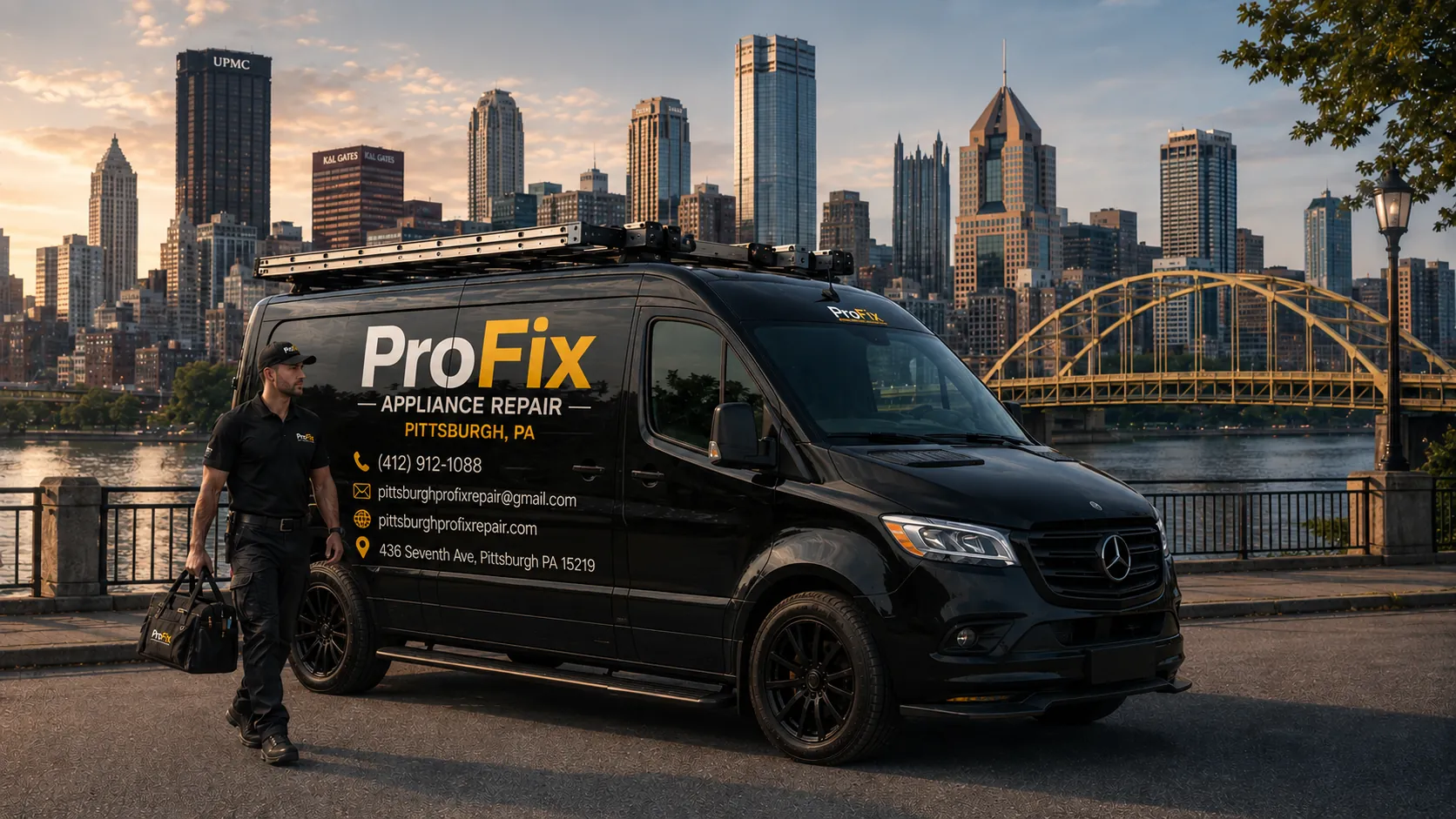
ProFix Appliance Repair Pittsburgh is Bellevue, West View & the North Hills's trusted source for local True appliance repair. Our neighborhood technicians are specifically trained on True models and carry genuine OEM replacement parts, so most Bellevue, West View & the North Hills True repairs are diagnosed and fixed in a single visit — backed by a 90-day parts and 30-day labor warranty.
How It Works
Available Now · Pittsburgh, PA
Ready to schedule your repair?
ProFix Appliance Repair Pittsburgh — trusted by thousands of Pittsburgh homeowners. Same-day slots available.
True Appliance Repair in Bellevue, West View & the North Hills — Common Questions
Can't find your answer? Book a service call or call us now.
Still have questions?
Our Pittsburgh team is ready — same-day service across Allegheny County.