

Wolf Certified — The North Side
Wolf Repair Near Me in The North Side, Allegheny County, PA
Local Wolf appliance repair near you in The North Side — certified neighborhood technicians, genuine OEM parts, same-day availability across Allegheny County.
Mon–Sat 7am–8pm · Sun 9am–5pm
Schedule Your Repair
Service Type
What type of service do you need?
Or call us directly:
(412) 912-1088Wolf Appliances We Repair in The North Side
Wolf engineering and service implications
Founded in United States and building appliances since 1934, Wolf competes in the luxury segment — but the useful fact for anyone holding a broken one is architectural, not historical. Dual-stacked sealed burners, infrared broilers, paired commercially with Sub-Zero is the design commitment the rest of the machine is arranged around, and it dictates what wears, what fails first, and what a competent diagnosis looks for before anything is unbolted. Across Allegheny County that matters commercially too: owners here keep appliances a long time — a fifteen-year-old machine in daily service is unremarkable, and the repair-versus-replace calculation tilts toward repair more often than in newer markets.
The single most useful thing to know about servicing Wolf is this: Wolf and Sub-Zero are the same parent company and are frequently installed together, so we service them as a pair. Technicians who work across every brand without accounting for it will reach the wrong conclusion on Wolf equipment more often than the fault rate justifies, and the customer pays for that in unnecessary parts. It matters more here than it would elsewhere, because parts run through Pittsburgh-area distributors with next-day access to Cleveland and Philadelphia stock — a wrong part is not just wasted money but a second appointment.
In practice that means we approach Wolf equipment with a specific order of checks rather than a generic one. Building around dual-stacked sealed burners changes what a noise, a temperature drift or an intermittent electrical fault most likely indicates, and starting from the brand's actual architecture is faster and cheaper than starting from the symptom alone. In Pittsburgh we add one more input before touching anything: 60-amp and early 100-amp panels are still in service in pre-war housing, and a dedicated 20-amp appliance circuit is the exception rather than the rule.
Built-in, integrated and why installation is half the diagnosis
Luxury appliances are usually installed rather than placed: built into cabinetry runs, fitted with custom panels, ducted into dedicated ventilation, and levelled to tolerances that matter. That makes the installation an active part of how the appliance behaves, and a meaningful share of what presents as appliance failure originates in it.
The recurring examples are consistent across the segment: cabinet ventilation blocked by a later renovation so the condenser cannot breathe, a custom door panel that has warped and is loading the hinge, or a unit shimmed out of level inside its opening so doors no longer seal. Each looks like a machine fault and none of them are fixed by replacing the machine.
Parts move through factory channels rather than general supply, so lead times run in weeks rather than days and a wrong diagnosis costs the customer real time. We confirm the exact model and serial before ordering, and we tell you a realistic timeline up front rather than after a part fails to arrive.
The compensation is that these machines are built to be serviced for decades. A twenty-year-old luxury appliance with a failed component is very often worth repairing, where its mainstream contemporary would be scrap.
Wolf in Pittsburgh homes
Wolf equipment does not meet Pittsburgh on neutral ground. The governing local factor is winter cold and repeated freeze–thaw cycling, with basements and garages routinely dropping below the roughly 40°F ambient that household refrigeration is rated for, and it is present whether or not the machine was specified for it. Because Wolf guidance is written against average conditions rather than these, domestic units here age on a different curve than the documentation assumes.
Climate is only half of it; for Wolf the building matters just as much. Allegheny County is one of the oldest housing stocks in the country, much of it predating 1940, with narrow rowhouse kitchens, steep basement stairs and hillside access, and that is the setting every Wolf here has to work in. It bears directly on igniter and spark module faults, because how the machine was fitted governs both how fast that fault develops and whether it can be put right without pulling the appliance out.
Then there is water, which most owners never think about until something scales up. Pittsburgh runs moderately hard water at roughly 7–9 grains per gallon, delivered untreated to Wolf fill valves, spray arms and any water-fed part. Our refrigeration peak is winter rather than summer, which inverts the pattern most manufacturers design their service guidance around. A Wolf follows the same seasonal pattern.
Common Wolf failure points we see
Look at enough Wolf equipment in Pittsburgh and the same faults keep surfacing: igniter and spark module faults; oven temperature calibration drift. That list belongs to this brand rather than to appliances generally, and knowing it before a panel comes off accounts for most of the diagnosis.
We service Wolf oven, cooktop, stove, range and the rest of the line. Each appliance type fails differently even within one brand, so the Wolf refrigerator diagnostic path and the Wolf laundry diagnostic path share very little beyond the parts channel. Across Allegheny County the mix skews by housing type as much as by brand, since owners here keep appliances a long time — a fifteen-year-old machine in daily service is unremarkable, and the repair-versus-replace calculation tilts toward repair more often than in newer markets.
Where Wolf equipment faults intermittently, the installation is the first thing we rule out and the control board is close to the last. On luxury machines that sequencing is worth real money to the customer, because the two ends of that list differ in cost by an order of magnitude — and in Allegheny County the expensive end also carries a wait, since parts run through Pittsburgh-area distributors with next-day access to Cleveland and Philadelphia stock.
Allegheny County adds its own layer to any Wolf service history. Because the governing stressor here is winter cold and repeated freeze–thaw cycling, the components in its path age faster than Wolf designed for, compressing an eight-year failure into something closer to five.
Wolf parts, warranty and lead times
Parts availability for Wolf is a real factor in the repair decision: factory channel, specialist-only. We confirm Wolf availability before quoting rather than after, because a diagnosis you cannot act on is worth nothing, and on luxury equipment the difference between a stocked part and a special order is the difference between one visit and three weeks. Locally, parts run through Pittsburgh-area distributors with next-day access to Cleveland and Philadelphia stock, which is why we check stock against your model number rather than the brand alone.
Our warranty on Wolf work is 90 days parts, 30 days labour, identical to every other brand we handle. If your unit is still covered by Wolf's own warranty we will say so and send you there instead, because doing the work ourselves would cost you the coverage you already paid for.
When a Wolf part is truly out of production we tell you plainly and set the repair cost against a new machine, instead of fitting an approximate substitute that buys six months and a second fault. How often that comes up varies by brand; for Wolf the binding constraint tends to be cost rather than availability. It is worth adding that in Allegheny County, owners here keep appliances a long time — a fifteen-year-old machine in daily service is unremarkable, and the repair-versus-replace calculation tilts toward repair more often than in newer markets.
Our Wolf coverage takes in the East End, the North Side, Mt Lebanon and the South Hills along with the rest of Allegheny County. Morning bookings generally get a same-day slot, and no part of the county carries a travel surcharge.
Wolf maintenance that actually matters here
Nearly everything that cuts a Wolf's life short in Allegheny County could have been avoided, and almost none of it appears in the owner's manual — which was written for average conditions, not for winter cold and repeated freeze–thaw cycling. If you do only one thing to a Wolf, keep the condenser and heat-exchange surfaces clean. Airflow restriction forces the compressor or element into continuous overwork, and continuous overwork is precisely what converts a ten-year machine into a six-year one.
The second factor for Wolf is water. With moderately hard water at roughly 7–9 grains per gallon reaching every water-fed Wolf component untreated, inlet screens, spray arms and fill valves scale gradually rather than failing suddenly. On Wolf that shows up first as declining performance that owners adapt to without noticing — longer cycles, poorer cleaning, slower ice production — and by the time it is reported the deposit has usually been building for years. On Wolf equipment, descaling on a schedule costs a fraction of the repair it prevents.
Third is the installation, which for Wolf in Allegheny County housing is a genuine failure driver rather than a formality. One of the oldest housing stocks in the country, much of it predating 1940, with narrow rowhouse kitchens, steep basement stairs and hillside access means clearances, drain heights and vent runs are frequently outside specification from the day the appliance went in. Those do not announce themselves; on Wolf they present years later as component failures, and correcting the installation resolves what replacing the part does not.
If you own Wolf equipment here and want one piece of advice: have the failure points specific to the brand — igniter and spark module faults — checked before they fail rather than after. On luxury equipment that inspection costs far less than the emergency call it avoids, and it is the difference between a scheduled repair and a ruined weekend — a bigger gap in Allegheny County than most places, because basement laundry at the foot of a steep half-turn stair is the norm rather than the exception, which decides what can be carried out and what has to be repaired in place.
Wolf in The North Side — Service Snapshot
Based on ProFix Wolf service calls across Allegheny County over the last 12 months.
Other Brands We Service in The North Side















































Built for Pittsburgh — Homes, Condos & More
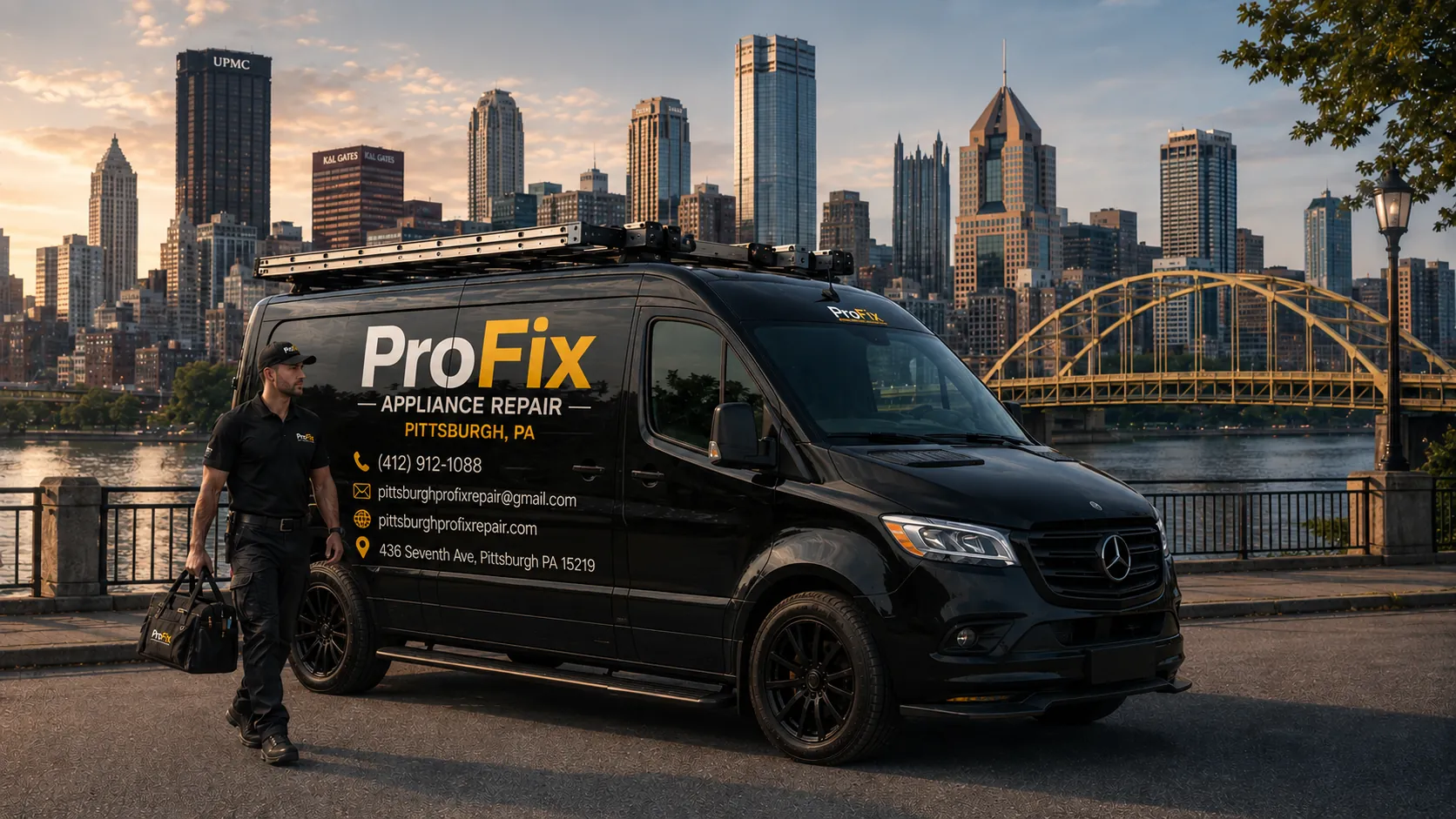
ProFix Appliance Repair Pittsburgh is The North Side's trusted source for local Wolf appliance repair. Our neighborhood technicians are specifically trained on Wolf models and carry genuine OEM replacement parts, so most The North Side Wolf repairs are diagnosed and fixed in a single visit — backed by a 90-day parts and 30-day labor warranty.
How It Works
Available Now · Pittsburgh, PA
Ready to schedule your repair?
ProFix Appliance Repair Pittsburgh — trusted by thousands of Pittsburgh homeowners. Same-day slots available.
Wolf Appliance Repair in The North Side — Common Questions
Can't find your answer? Book a service call or call us now.
Still have questions?
Our Pittsburgh team is ready — same-day service across Allegheny County.